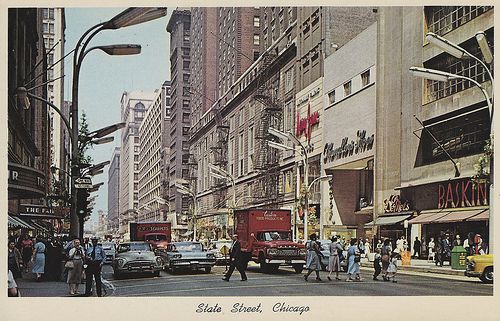
State Street
Where I came from, a suburb right outside Chicago, people knew we had done the wrong thing to Negroes. Still, they weren’t sure they could side with Martin Luther King, whose namesake had defied the Pope. And how bad were the problems, anyway? The Catholic schools I attended mid-century taught Chicago history that was mostly good news: settlement houses like Hull House had helped thousands of European immigrants settle in. No one mentioned that these neighborhood mainstays were segregated, or that they clued newcomers in on who would be beneath them, who was at the bottom of American society. Decades later, doing research for my memoir, I learned that in 1915, for instance, the Gads Hill Social Settlement House declared its blackface performance for new Polish arrivals “a great success.”
After dropping out of college mid-semester and drifting backwards into my summer job, I surprised myself by starting to date a guy from across the color line. One day, very early in our relationship, Emmon and I decided to do a little shopping in the Loop. Being there brought me back to my suburban childhood.
In the sixties, State Street’s wide sidewalks would fill shoulder to shoulder with families from the suburbs or from the old neighborhoods. Few women still wore white gloves, but they had ironed their pleated shirtwaists. I remember the rubbery whoosh of the revolving door as my beloved grandmother led me into the cathedral-like interior of Marshall Fields, how her posture stiffened and her chin rose. Born to scrapper Irish immigrants, she’d gotten a job modeling fur coats when my elegant, introvert grandfather lost his heart to her. He made a ton of money on LaSalle Street, Chicago’s version of Wall Street. When the crash came, they had to let most of the servants go. A decade after Nana had last taken me for a snowman sundae in Field’s Walnut Room, with its shimmering three-story tree, I was walking with Emmon down State Street when I caught a glimpse of two patrolmen heading in our direction. Before I knew what was happening, my new boyfriend’s presence melted to the side.
Daley’s Finest were wide in girth, at ease, well-armed. They were walking in the crowd with a confident swagger. Suddenly, they stopped and stared—really stared. I glanced behind me for what might have caught their attention – a drunk staggering, about to fall, a pickpocket – then back into their hard eyes. One put his hand on his billy club. I followed Emmon away.
So far Emmon had said little about racism or he spoke in code, as if it were an embarrassing family secret. But now, on the other side of the street, he looked squarely into my confused face and said,
“Gail, if I accidentally brush up against a cop, or if a cop ‘accidently’ brushes against me, the police report could read that a Negro male had assaulted an officer who had in turn been forced to subdue him.”
“Oh,” I said, walking on next to Emmon, too stunned to close my mouth.
I thought about the cold rage I’d seen in the patrolmen’s faces, the way their gait had slowed and their big, muscular bodies tightened. Clearly the message was violence; it just wasn’t clear why it was being sent. I knew the city had a vicious race problem, but the police were supposed to be neutral.
The worst thing about the incident was Emmons’s idea that the cops would actually start something. That the police created problems and didn’t just solve them was a real flip. Could it be true? The menace not just in their eyes but in their jaws and shoulders left me totally confused and physically shaken. The word “subdued” repeated itself over and over in my mind.
This was my first serious relationship. The loud, goofy boys I knew in my Catholic parish were beneath me, of course, but I made no real effort to meet any others. I was shy, we had no car and practically no money. But there was a deeper reason, one that I kept to myself. I had learned through violence that I attracted what was ugly in men, so nothing could change the fact that I was ugly. After we were introduced by my roommate, Emmon pursued me in a friendly, light-hearted way. For some reason, it worked. Soon we were whispering stories to each other about our AWOL fathers. I felt listened to in a way I was deeply hungry for.
It would have been fine with me if people on the street had left us entirely alone: I needed time to figure out who Emmon was and what a relationship might actually mean. But instead, just the opposite happened. Pedestrians reacted with looks that combined shock, revulsion and irritation, as if they had just missed stepping in excrement. I took it as proof that a lot of people were just plain stupid. I insisted to myself that the idiocy of individuals, no matter how many there were, was not going to deprive me of my happiness. But the patrolmen’s glare was now adding a completely different element. Soon I would see that the police don’t just maintain law and order; they also maintain the social order. It was in their unwritten job description to threaten us. That’s what we are being asked to consider now, with critical race theory, or whatever you choose to call examining our present social structures through the lens of the past. It was never just about individuals, and the behavior of the cops that day was my first clue.
 WhiteWifeChicago1968.blog